
Libraries without classification
There is a new library at the Museum of Old and New Art (MONA) in Hobart. This interested me firstly, because it’s a library and secondly, because they’re doing things a bit differently.
There is a new library at the Museum of Old and New Art (MONA) in Hobart. This interested me firstly, it’s a library and secondly, because they’re doing things a bit differently.
Most libraries have a classification system that dictates the order in which the books will be stored and where to find the books on the shelf (if indeed there are books on the shelves any more in some libraries). These systems are based on particular understandings of knowledge and are often biased towards a Western, Anglo point of view. In Australia this is usually the Dewey Decimal System, but it could also be the Library of Congress system.
The MONA library - Phrontisterion - doesn’t use Dewey or LC. It uses “the O”. O is not a pre-defined classification system for the collection; it is a system for tracking it. Visitors to the library can examine items, move them around, leave them wherever they want. There is no “right” place for them.
The library’s website explains it thus:
“We don’t have Dewey. We have the O. Use it to find out about the books and other bibliophilic paraphernalia on display. The O knows where every title is in the library, no matter where things have been put back on the shelves.”
The library collection is that of David Walsh, the founder of MONA. Like all personal libraries it reflects the interests, obsessions and foibles of its owner.
This kind of library is unusual, but not new.
Art historian Aby Warburg created his own library that worked similarly. His theory of “the good neighbour” underpinned his approach to classifying items and patron use of the Warburg library in London. In Warburg’s view, the collection is a ‘neighbourhood’ where books have ‘conversations’, through which patrons can make connections in their research. Warburg arranged his collection to reflect his view of the relationships between different kinds of knowledge and its subjects. He rejected traditional disciplinary boundaries and was forever arranging and re-arranging his collection as his understanding of his fields of interest developed. Re-arranging his library was part of his scholarly work.
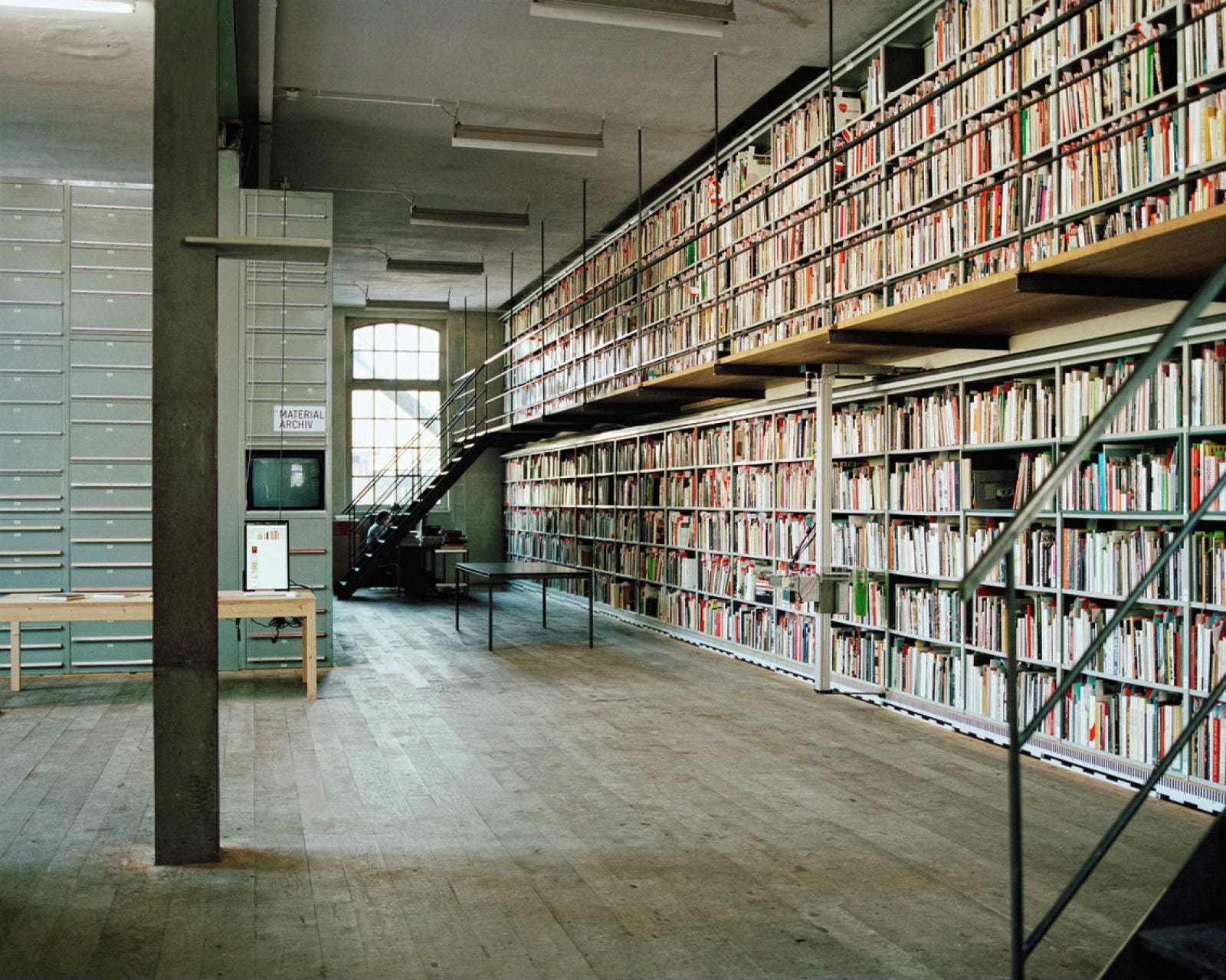
The Sitterwerk library in St Gallen, Switzerland is another personal collection that became a library. Daniel Rohner also constantly re-arranged his collection as part of his scholarly practice and the current library is arranged using the same principle. Books in the Sitterwerk are not arranged according to Dewey or another formal classification system. Library patrons can move them about, reshelve them where they want or create their own mini collections as they work. A scanner is run over the collection regularly to read the RFID tags in each book, which creates a catalogue of the physical location of each book.
Libraries, for me, have always been about browsing and making connections between items. They are about finding things you didn’t know you wanted or needed. Phrontisterion at MONA, like the Warburg and the Sitterwerk, allows patrons to browse and make their own connections, to find things and go down rabbit holes even more so than a more formally arranged library. It breaks the bonds of shelf organisation and allows for a slightly freer flow of connections through physical placement.
On its website, Phrontisterion is compared to a hyperlink: “Let (the O) chart you a course through the collection, linking books—by association, theme or obscure whim—as webpages hyperlink ideas”.
Sometimes I think we’ve lost an appreciation of the power of the hyperlink. The first time I used the web I was doing an undergraduate degree. I was using databases for lit searches but the web blew my mind. I could move laterally in my thinking and now I was using this thing that could move with me and more importantly, provide me with connections unavailable through previous media. To say it changed my life would not be overstating things. Chat bots are killing the magic of the hyperlink. They are dead ends, not lateral paths to new and novel knowledge. To read the quote above gave me hope.
Phrontisterion is curated by its librarians, not David Walsh, which is a heartening endorsement of librarians and their ability to not only understand their collections, but to help shape the way the collection, and by extension knowledge, is understood. In a time where an answer can be spat back at you from any number of AI systems with little or no context, Phrontisterion is a big up yours to the AI slop that increasingly threatens to deaden our curiosity and our research skills. I would argue that libraries of all types stand as a bulwark against the question-answer distribution of knowledge that AI encourages.
One of my favourite quotes from a librarian is from Frederick Kilgour, who was instrumental in the adoption of the first digital library catalogues in the United States. He said:
“Ideally, a college library should automatically reorganise itself for each individual user”.
I had this quote pinned above my desk for years, while I wrote a thesis. I loved it.
What I question now though, is if the desire to customise and personalise has been taken too far. We are given exactly what companies think we want. We are curated into submission, locked into chat boxes that narrow our world and lessen our resistance. It all becomes too hard.
While Kilgour could not possibly have predicted AI as we know it now, and how it would flatten our research ability, he understood that everyone experiences collections differently and ideally, each library would shape itself to the way in which individual patrons want to use it. In the early days of the web I would dream of designing website architectures that could accommodate these different understandings, these different needs. I also knew that sometimes we need to come up against a system that allows us to see things in a different way, to learn. This is what I found in the library.
I’ve never been to the Warburg or the Sitterwerk, but hopefully soon I will get to Phrontisterion.
Thank you, as always, for reading. Don’t worry sports fans, the sports writing will be back soon.
Georg x
I write this stuff because I have to, it’s a compulsion. However, if you like it and you want to show your appreciation, I admit that I get pretty chuffed when someone ‘buys me a coffee’ (pays me a little bit).